Contents
Profile
Species: vorax
Range: Late Cretaceous (70-66 MYA) from Alberta, Canada to Wyoming, possibly New Jersey
Size estimate: 3 ft length, 5-11 lbs
Discovery: Othniel Charles Marsh, 1889
Classification: mammalia, metatheria, marsupialiformes, stagodontidae
True to Life?
Since no one has ever seen a living dinosaur, and the missing pieces of the fossil record withhold important clues to their appearance, no artistic representation of a dinosaur ever gets it 100% right. On top of that, new discoveries can change our ideas of extinct creatures drastically. So, how close does this sculpture come to what we know of the original animal?
• This sculpture gets tricky to critique because until recently the genus described only jawbones , teeth, and other fragments, mostly from the skull. Due to the similarity of the shapes of the jaw and its teeth to that of a modern possum, scientists and artists alike have usually assumed the rest of it looked like a possum too.
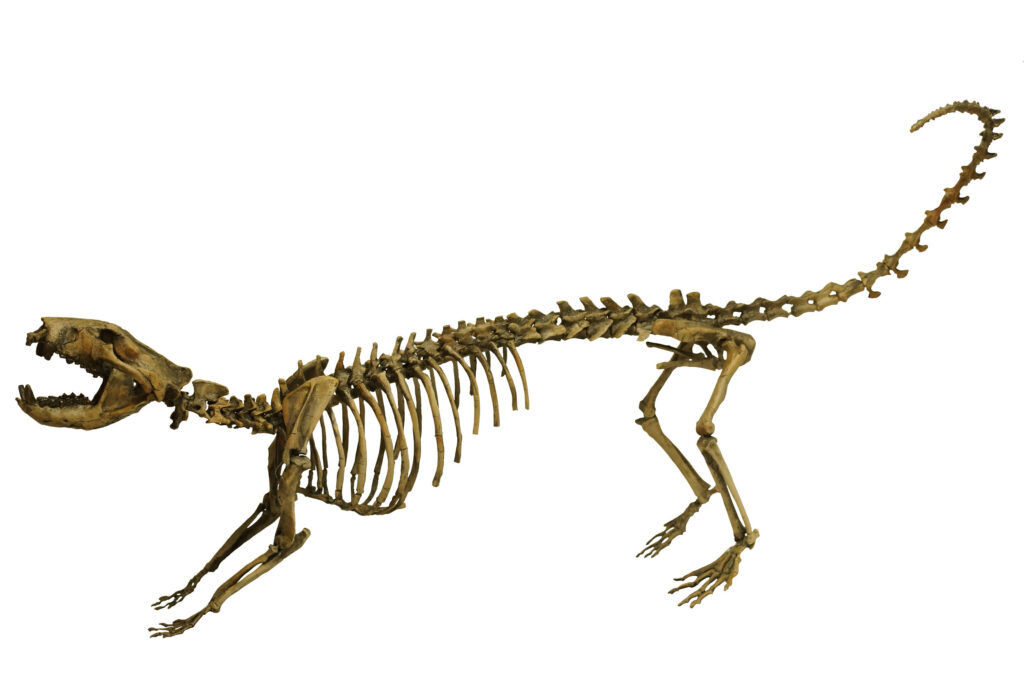
• A new but as-yet-undescribed discovery has uncovered most of the skeleton, significantly changing our understanding of its size, appearance, and lifestyle. It measured over 3 feet in length and better resembled a Tazmanian devil than an possum. Given its squat legs, long and sinuous torso, and long tail, it would also be fair to say it resembled an otter as well. Given how the rock surrounding the skeleton included layers of concretion and considering the fact that it was found only 40 feet from a Triceratops skeleton clearly buried by river currents dumping silt, scientists believe that it died in its burrow on the river’s bank. Fluctuations in the level of the water table slowly and gently built up a layer of protective minerals, keeping the skeleton localized in the same place and preserving it.
• Needless to say, if it was burrowing and swimming, it likely would have lacked the prehensile tail hinted at here and probably would not have climbed over this horn as shown. Likewise, it may have had small ears, so this sculpture may have that in common with the real thing.
• Other studies on two nearly complete Didelphodon skulls determined that it had one of the highest proportional bite forces of any known mammal, living or dead. Consequently, this snouty depiction of its head does not do the robustness of its jaws justice. From the top, the head resembled a rounded triangle, with a very low profile. Its bottom jaws had a rounded lower margin, giving it a rectangular profile overall and possibly an optical illusion of a downturned mouth unless soft tissues obscured its lines. As such, it may have looked a little more dour or grim-faced than adorable like an otter. Its eyes were positioned about halfway along the length of its head, while its ears would have attached to the back of the skull about midway down the profile of the whole head.
• Behind-the-scenes: We do not know if the sculptor of this statue intended it to depict Didelphodon, but we decided to assign it to this taxon for art history reasons. Because a famous paleontologist (O.C. Marsh) named it way back in 1889, it became a minor icon of the Mesozoic, figuring large in the artistic trope portrayed here of the tiny mammal triumphing over the dead dinosaurs. We now know more about the mammals of this era as well as more about Didelphodon itself, so the time may have come to reassign the sculpture you see here to another, more appropriately possum-shaped Cretaceous mammal and craft a new sculpture to reflect the new discoveries of Didelphodon’s actual look.
 1:00–3:00 PM
 George S. Eccles Dinosaur Park, Ogden, UT